




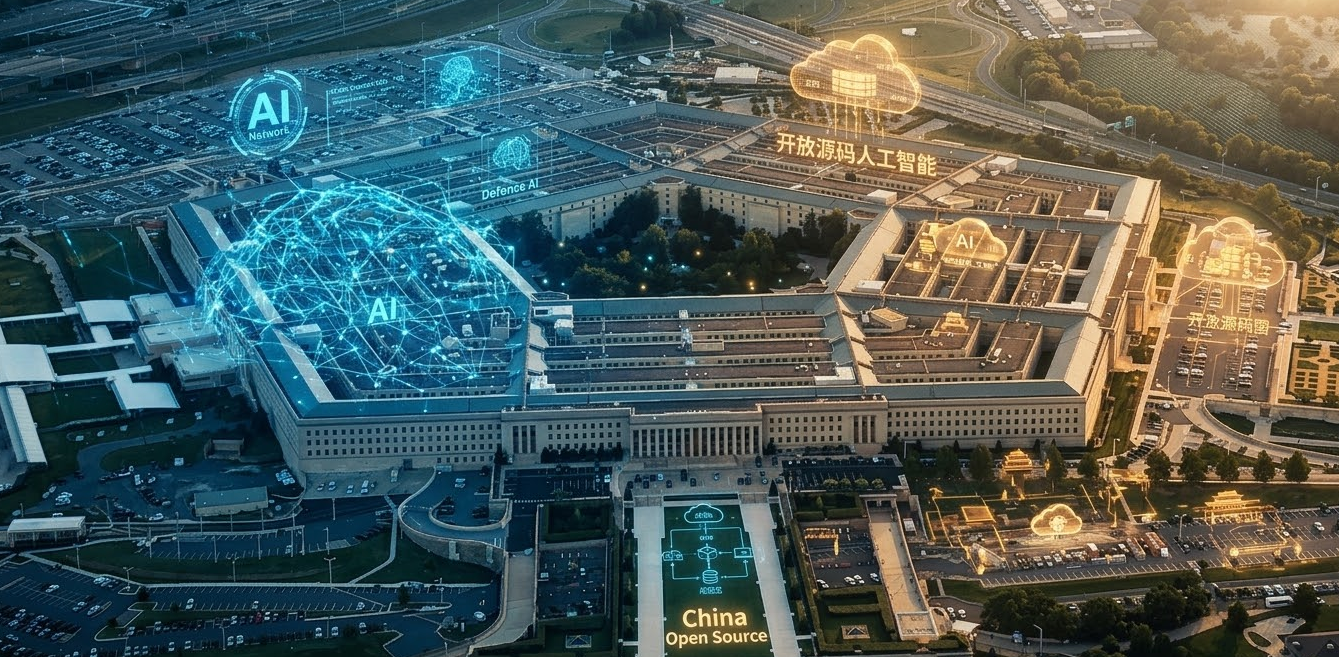
China open source AI threatens US AI lead as a new warning from a US advisory body highlights growing concerns inside the Pentagon. The report suggests that China’s dominance in open-source artificial intelligence could weaken America’s position in military and technological power. At the same time, the Pentagon is struggling with a major internal challenge — replacing Claude AI, a tool widely used by military teams, is proving far more difficult than expected.
Background: Rising AI Tensions Between US and China
The global race in artificial intelligence is intensifying, especially between the United States and China. While the US has traditionally led in advanced AI development, China is rapidly gaining ground through open-source AI models.
Unlike closed systems, open-source AI allows developers worldwide to access, modify, and improve AI models freely. This approach has helped China accelerate innovation and adoption at scale, raising concerns among US officials about losing strategic advantage.
Pentagon Orders Phase-Out of Claude AI
The Pentagon recently ordered a gradual phase-out of Claude AI, developed by Anthropic, due to policy concerns related to AI usage restrictions. These restrictions limit the use of AI in areas such as weapons development and surveillance, which are critical for military operations.
Officials believe these limitations could impact national security operations. As a result, the Department of Defense is exploring alternative military AI tools that offer fewer restrictions and more flexibility.
Why Claude AI Is Being Removed
The decision to remove Claude AI is not about performance but policy alignment. The AI system enforces strict ethical guidelines, which restrict how it can be used in sensitive or classified environments.
For military use, these restrictions create operational challenges, especially in areas like intelligence analysis, cybersecurity, and battlefield simulations.
Military Users Resist the Change
Despite the Pentagon’s directive, many military users are resisting the removal of Claude AI. The main reason is its deep integration into existing systems and workflows.
Claude AI is widely used across departments for:
- Coding and software development
- Data analysis and intelligence processing
- Handling classified and sensitive tasks
Replacing such a deeply embedded system is not easy. Experts suggest that transitioning to a new AI platform could take several months or even up to 18 months.
Integration Challenges
Military teams have built tools, scripts, and workflows around Claude AI. Switching to a new system would require retraining personnel, rebuilding infrastructure, and ensuring compatibility with existing systems.
This makes the transition not only time-consuming but also risky for ongoing operations.
Impact on the AI Industry
This situation highlights a broader issue in the AI industry — the balance between ethical AI development and practical use in defense and security.
Companies like Anthropic are focusing on safe and responsible AI, while governments require more flexible systems for national security purposes. This mismatch is creating tension between private AI developers and public sector needs.
At the same time, China’s open-source strategy is putting additional pressure on US companies. By making AI tools widely available, China is enabling faster global adoption, which could shift the balance of power in AI innovation.
Future Implications for Global AI Leadership
The warning about China’s open-source dominance is a wake-up call for the United States. If current trends continue, the US could lose its leadership position in AI, especially in areas related to defense and infrastructure.
For the Pentagon, the challenge is twofold:
- Find a replacement for Claude AI that meets military needs
- Maintain technological superiority in a rapidly evolving AI landscape
The outcome of this transition will likely shape the future of military AI tools and influence how governments collaborate with private AI companies.
Conclusion
The clash between policy, technology, and national security is becoming more visible as AI adoption grows. While the Pentagon pushes to remove Claude AI, resistance from military users shows how deeply integrated these tools have become.
At the same time, China’s open-source AI strategy is challenging the US in new ways. The coming months will be critical in determining whether the US can adapt quickly enough to maintain its global AI leadership.
For more insights on this developing AI conflict, you can explore our detailed coverage on Pentagon Claude AI removal and military resistance, where we break down why defense teams are struggling with the transition. You can also read about the growing AI race in our report on Samsung’s massive AI chip investment in 2026, highlighting how global tech players are competing for dominance. Additionally, don’t miss our analysis on how AI is replacing jobs, which explains the broader impact of artificial intelligence on industries. For more updates on major AI deals, check our coverage of the Microsoft and Amazon OpenAI cloud deal shaping the future of enterprise AI.