


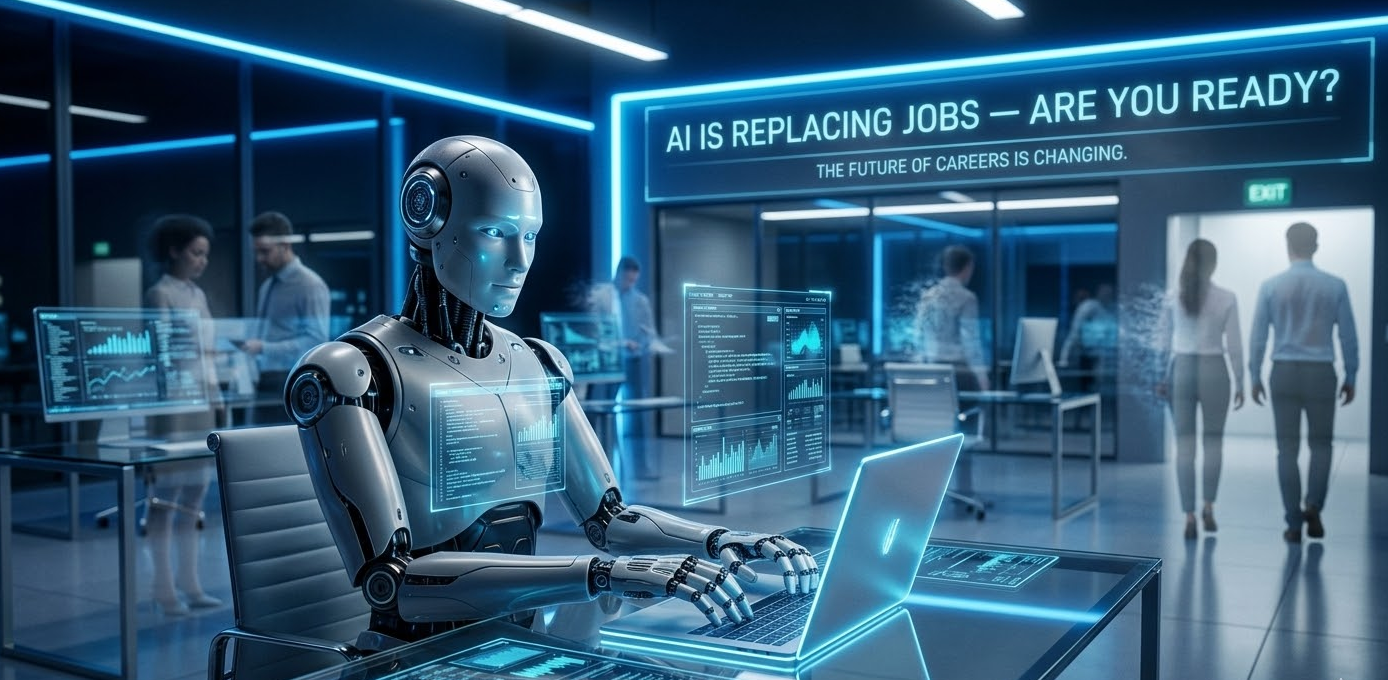
How AI Is Replacing Jobs: Which Careers Are at Risk and How to Stay Relevant in 2026
Artificial Intelligence (AI) is no longer just a futuristic concept it’s already transforming the way we work, hire, and build careers.
From automating repetitive tasks to making complex decisions, AI is reshaping industries at an incredible pace. While this brings efficiency and innovation, it also raises an important concern:
👉 Will AI take your job?
👉 Which careers are most at risk?
👉 How can you adapt and stay ahead instead of being replaced?
In this detailed guide, we’ll explore:
- The real impact of AI on jobs
- High-risk careers you should know about
- Jobs that are safe (for now)
- Practical strategies to future-proof your career
What Is AI and Why Is It Replacing Jobs?
Artificial Intelligence refers to machines or software that can perform tasks that typically require human intelligence.
These include:
- Learning from data
- Understanding language
- Solving problems
- Making decisions
Modern AI tools can now:
- Write content
- Generate code
- Design graphics
- Analyze data
- Handle customer queries
👉 The key reason AI is replacing jobs is simple:
If a task is repetitive, predictable, or rule-based — AI can likely do it faster, cheaper, and more efficiently.
Jobs That Are Most at Risk Due to AI
Let’s break down the jobs that are most vulnerable in the age of AI.
1. Data Entry Jobs
Risk Level: 🔴 Very High
Data entry roles involve:
- Filling spreadsheets
- Managing records
- Processing forms
AI-powered automation tools can now complete these tasks in seconds with higher accuracy.
👉 Future Outlook:
Manual data entry jobs are rapidly declining and may almost disappear in the coming years.
2. Customer Support (Basic Level)
Risk Level: 🔴 High
AI chatbots and virtual assistants can now:
- Answer FAQs
- Resolve basic complaints
- Track orders
Many companies are replacing human agents with AI for first-level support.
👉 Future Outlook:
Only complex customer service roles requiring emotional intelligence will remain human-driven.
3. Content Writing (Basic/Generic Content)
Risk Level: 🔴 Medium to High
AI tools can now generate:
- Blog posts
- Product descriptions
- Social media captions
👉 However, AI still struggles with:
- Creativity
- Deep research
- Emotional storytelling
👉 Future Outlook:
Low-quality, generic writing jobs will decline, but skilled writers will still be in demand.
4. Graphic Design (Basic Tasks)
Risk Level: 🟠 Medium
AI design tools can create:
- Logos
- Social media posts
- Simple banners
👉 But high-level creative branding still requires humans.
👉 Future Outlook:
Basic design jobs may decline, but creative professionals will evolve alongside AI.
5. Accounting & Bookkeeping (Basic Tasks)
Risk Level: 🟠 Medium
AI software can:
- Manage invoices
- Track expenses
- Generate reports
👉 Future Outlook:
Basic accounting roles may reduce, but financial strategists and advisors will remain valuable.
6. Retail Cashiers
Risk Level: 🔴 High
Self-checkout systems and automated stores are replacing:
- Cashiers
- Billing staff
👉 Future Outlook:
Physical cashier roles will continue to decrease globally.
7. Manufacturing & Factory Workers
Risk Level: 🔴 High
Robots and automation systems can:
- Assemble products
- Perform repetitive tasks
- Work 24/7 without breaks
👉 Future Outlook:
Low-skilled factory jobs are highly vulnerable.
8. Translators (Basic Translation)
Risk Level: 🟠 Medium
AI tools can translate languages instantly.
👉 However, they struggle with:
- Cultural context
- Tone and nuance
👉 Future Outlook:
Professional translators will still be needed for high-quality work.
Jobs That Are Safer From AI (For Now)
Not all jobs are at risk. While AI is transforming many industries, some careers are actually becoming more valuable and future-proof because of it. These roles require human intelligence, creativity, emotional understanding, or physical presence — areas where AI still struggles.
Let’s explore them in detail:
1. AI & Tech-Related Jobs
- AI Engineers
- Data Scientists
- Machine Learning Experts
👉 These roles are not just safe — they are booming globally.
As companies adopt AI, they need skilled professionals to:
- Build AI systems
- Train machine learning models
- Analyze large datasets
- Improve automation processes
👉 Why they are safe:
AI cannot build or improve itself without human expertise (at least for now).
👉 Future Insight:
Learning AI, coding, or data skills today can open doors to high-paying and long-term career opportunities.
2. Creative Professionals
- Writers (high-quality, storytelling, SEO experts)
- Filmmakers
- Designers (advanced level, branding experts)
👉 Creativity is still a human superpower.
While AI can generate content, it often lacks:
- Original ideas
- Emotional depth
- Cultural understanding
- Brand storytelling
👉 Why they are safe:
Creative work requires imagination and uniqueness — something AI struggles to replicate fully.
👉 Future Insight:
Basic content creation may decline, but high-level creative professionals will be in even higher demand.
3. Healthcare Professionals
- Doctors
- Nurses
- Therapists
- Surgeons
👉 Healthcare is one of the most secure industries.
AI can assist in:
- Diagnosing diseases
- Analyzing medical reports
- Suggesting treatments
But it cannot replace:
- Human empathy
- Patient care
- Ethical decision-making
👉 Why they are safe:
Patients trust humans, not machines, especially in critical situations.
👉 Future Insight:
Healthcare professionals who use AI tools will become even more efficient and valuable.
4. Skilled Trades
- Electricians
- Plumbers
- Mechanics
- Technicians
👉 These are hands-on, physical jobs.
AI and robots still struggle with:
- Working in unpredictable environments
- Handling real-world physical tasks
- Fixing unique, on-site problems
👉 Why they are safe:
Automation is expensive and difficult in this field.
👉 Future Insight:
Skilled trades will remain in demand and may even offer stable income with less competition.
5. Leadership & Strategy Roles
- Managers
- Entrepreneurs
- Business Strategists
- Decision-makers
👉 AI can analyze data, but it cannot:
- Lead teams
- Inspire people
- Make complex business decisions with emotional intelligence
👉 Why they are safe:
Leadership requires vision, communication, and human understanding.
👉 Future Insight:
Leaders who use AI for decision-making will outperform others.
How to Protect Your Career in the Age of AI
Now comes the most important question:
👉 What should YOU do to stay safe and grow?
1. Learn AI — Don’t Ignore It
Instead of fearing AI, start using it as a tool.
- Learn tools like ChatGPT, Midjourney, and automation software
- Use AI for writing, research, design, or coding
- Understand how AI works in your industry
👉 Key Idea:
The future belongs to people who use AI, not avoid it.
👉 Pro Tip:
Even basic AI knowledge can give you a huge competitive advantage.
2. Upgrade Your Skills
Focus on skills that AI cannot easily replace:
- Critical thinking
- Problem-solving
- Creativity
- Communication
- Decision-making
👉 Why this matters:
AI can provide answers, but humans are needed to ask the right questions and make smart decisions.
👉 Pro Tip:
Invest time in learning skills that require thinking, not just doing.
3. Move Beyond Basic Work
If your job is repetitive or rule-based, it’s time to upgrade.
👉 Examples:
- Data entry → Data analysis
- Basic writing → SEO, copywriting, content strategy
- Customer support → Customer success or relationship management
👉 Why this matters:
AI replaces tasks, not people — but only if you evolve.
👉 Pro Tip:
Always aim to move from execution-level work to thinking-level work.
4. Build a Personal Brand
In the AI era, your identity and visibility matter more than ever.
- Start blogging or writing online
- Build your presence on LinkedIn
- Share your knowledge and experiences
- Create content in your niche
👉 Why this matters:
People trust real humans with real expertise, not anonymous AI.
👉 Future Advantage:
A strong personal brand can bring:
- Job opportunities
- Freelance clients
- Business growth
5. Learn Tech Basics
Even if you’re not a developer, basic tech knowledge is essential.
- Learn basic coding (HTML, Python, etc.)
- Understand AI tools and platforms
- Use productivity tools and automation
👉 Why this matters:
Technology is becoming part of every job.
👉 Pro Tip:
You don’t need to become an expert — just be tech-aware and adaptable.
6. Focus on Human Skills
AI cannot replace core human abilities like:
- Emotional intelligence
- Empathy
- Leadership
- Communication
- Team collaboration
👉 Why this matters:
These skills are essential in:
- Management
- Sales
- Healthcare
- Customer relations
👉 Future Insight:
As AI grows, human skills will become more valuable, not less.
7. Stay Adaptable
The most important skill in 2026 is adaptability.
👉 Be ready to:
- Learn new tools regularly
- Change your career path if needed
- Accept change instead of resisting it
- Continuously improve yourself
👉 Why this matters:
The world is changing fast — and only those who adapt will succeed.
👉 Golden Rule:
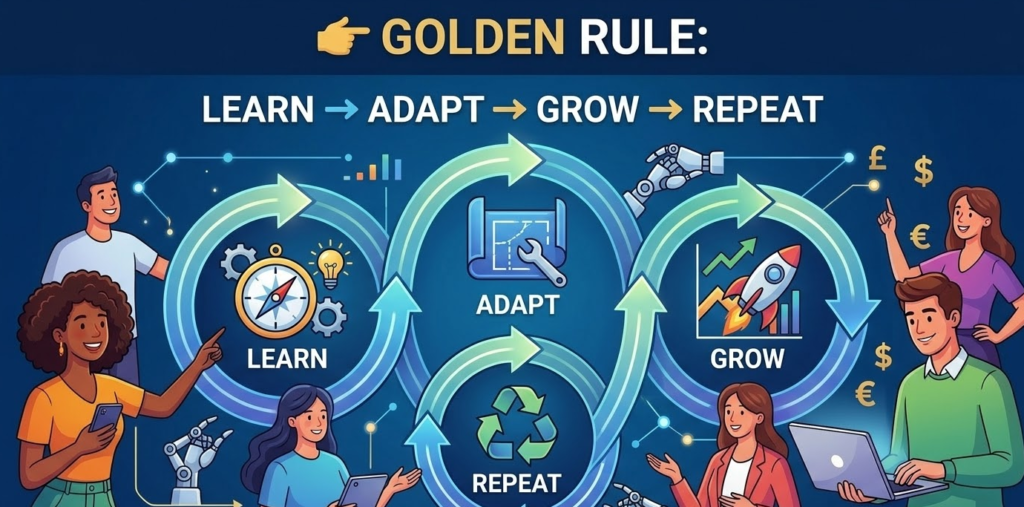
Learn → Adapt → Grow → Repeat
The Truth: AI Will Not Replace Everyone
Let’s be clear:
👉 AI will not replace humans completely.
👉 But it will replace people who don’t adapt.
History shows:
- Machines replaced manual labor
- Computers replaced paperwork
- Internet changed communication
Now AI is the next revolution.
Final Thoughts: AI Is an Opportunity, Not a Threat
AI is not your enemy — it’s a powerful tool that is reshaping the future of work.
Yes, some jobs will disappear.
Yes, many roles will evolve and change.
But at the same time:
👉 New opportunities are being created every single day.
From AI specialists to digital creators, the job market is shifting — not shrinking.
According to the World Economic Forum , millions of new jobs will emerge due to AI and automation, even as others are replaced.
Who Will Win in the AI Era?
The real winners in this AI-driven world will be those who:
- Learn fast and stay updated with new technologies
- Adapt quickly to changing industry trends
- Use AI smartly to increase productivity and efficiency
Instead of competing with AI, focus on collaborating with it.
Start Today — Not Tomorrow
If you want to stay ahead, start learning and exploring AI tools today:
- Try tools like ChatGPT for writing and research
- Explore Midjourney for design and creativity
- Learn new skills from platforms like Coursera or Udemy
The Bottom Line
👉 AI will not replace you.
👉 A person who knows how to use AI will.
So don’t fear the future-prepare for it.
Because in 2026 and beyond, success will belong to those who are smart, skilled, and AI-ready 🚀
Quick Summary
- AI is automating repetitive jobs
- Data entry, basic support, and simple tasks are at high risk
- Creative, strategic, and human-focused jobs are safer
- Learning AI skills is no longer optional
- Adaptation is the key to survival
Useful AI & Tech Resources
Explore these guides to boost your AI knowledge, productivity, and career skills:
AI Tools for Students
Discover the best free AI tools for students in 2026 to learn faster and smarter.
Choosing the Right Laptop
Check our comparison of Apple MacBook vs Windows laptops for students to support your AI workflow.
Reliable Tech Gadgets
Learn about the most repairable tech gadgets of 2026 to invest in devices that last longer.
AI for Business Growth
Explore AI tools for small business marketing in 2026 to improve business efficiency and results.
Content Optimization with AI
Learn how to rank higher using AI strategies in our Answer Engine Optimization (AEO) guide.
FAQs About AI Replacing Jobs (2026 Guide)
1. Will AI replace all jobs?
No, AI will not replace all jobs, but it will significantly transform many roles across industries. AI is mainly replacing repetitive and rule-based tasks, not entire professions. Jobs that require creativity, emotional intelligence, critical thinking, and human interaction will continue to exist and evolve. The future is not about humans vs AI — it’s about humans working alongside AI.
2. Which jobs are safest from AI?
Jobs that involve human skills, creativity, and physical presence are safest from AI. These include healthcare professionals (doctors, nurses), skilled trades (electricians, plumbers), leadership roles (managers, entrepreneurs), and creative fields (writers, designers). These roles require decision-making, empathy, and real-world interaction, which AI cannot fully replicate.
3. Is AI a threat to fresh graduates?
AI can be a challenge for fresh graduates, especially those entering fields with repetitive tasks. However, it is also a huge opportunity. Graduates who learn AI tools, digital skills, and problem-solving abilities can gain a strong competitive advantage in the job market. Being AI-aware makes you more employable, not less.
4. Can AI replace programmers?
AI cannot fully replace programmers, but it is changing how they work. Tools can now generate code, fix bugs, and automate tasks, which increases productivity. However, human developers are still needed for logic building, system design, and complex problem-solving. Programmers who learn to work with AI will be more valuable than ever.
5. How can I protect my job from AI?
To protect your career from AI disruption, you should focus on upgrading your skills continuously. Learn how to use AI tools, improve your critical thinking and communication skills, and move beyond repetitive work. Focus on creative, strategic, and decision-making roles. Building a personal brand and staying adaptable are also key to long-term career security.
6. Is content writing dead because of AI?
Content writing is not dead, but it is evolving rapidly. AI can generate basic and generic content, which reduces demand for low-quality writing. However, high-quality content that includes storytelling, SEO strategy, brand voice, and human emotion is still in demand. Skilled writers who use AI as a tool can actually grow faster in this field.
7. What skills are future-proof in the age of AI?
Future-proof skills include creativity, critical thinking, emotional intelligence, communication, and leadership. In addition, digital literacy and the ability to work with AI tools are becoming essential. These skills are difficult to automate and will remain valuable in almost every industry.
8. Should I learn AI in 2026?
Yes, learning AI in 2026 is one of the smartest career decisions you can make. You don’t need to become an expert, but understanding how AI works and how to use AI tools can significantly boost your productivity and job opportunities. AI is becoming a basic skill, just like using computers or the internet.
9. Will AI create new jobs?
Yes, AI is not only replacing jobs but also creating new ones. Roles like AI specialists, prompt engineers, data analysts, and automation experts are growing rapidly. As technology evolves, new industries and opportunities will continue to emerge, making it important to stay updated and adaptable.
10. Is AI good or bad for careers?
AI can be both good and bad, depending on how you respond to it. For those who ignore it, AI can be a threat. But for those who learn and use it effectively, AI is a powerful opportunity for growth. It can increase productivity, open new career paths, and help individuals stay competitive in the modern job market.